On the Jewish Metaphysics of Death
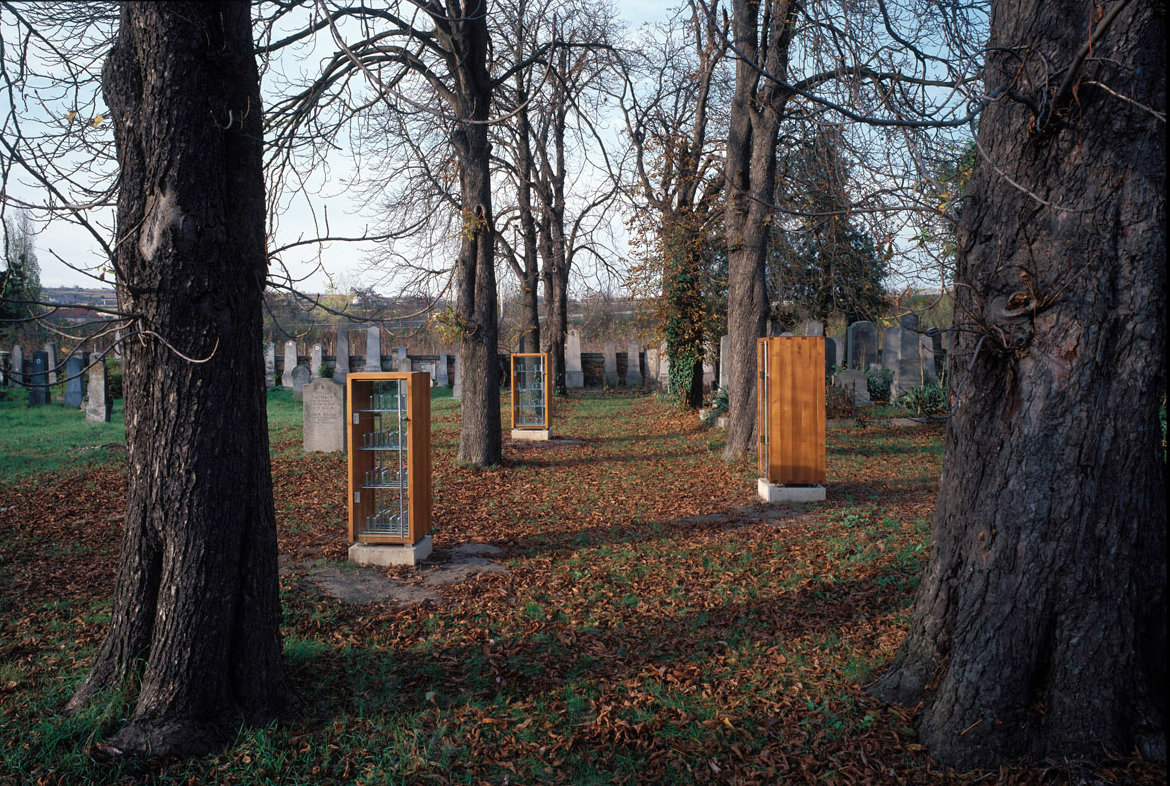
The Open Public Library in the Jewish Cemetery in Piaristenkirche Krems, Austria 2004
Introduction
This project is a latest in the series of Open Public Libraries by the artist team Clegg & Guttmann. It is a collection of books on the topic of the Jewish Philosophy of Death which is placed outdoors, in three weather protective bookcases, in the Jewish Cemetery in Krems.
The Jewish Cemetery in Krems has been unused since the Second World War. The Open Public Library in Krems is a revival project which will give a reason and an opportunity for a public access to one of the few reminders that there was once a lively Jewish community in this Lower Austrian city. The collection of books in the library is divided into three parts, one in each book-case. The first book-case contains original religious material in Hebrew. The second cabinet contains introductory material on Jewish law in German and English. The third part of the collection specializes in various topics related to the Jewish philosophy of death.
The Jewish grave stone in the Pieristische Kirche
The project originated from the discovery of a Jewish grave-stone from the 14th century embedded in one of the walls of the tower of the Pieristische Kirche in Krems. From an archeological point of view, it was an interesting discovery. The grave-stone is one of the few remaining objects associated with the Jewish community of Krems in this period. Rabbi Isaac, whose grave it was, must have been a member of the first generation of Jews who settled in Lower Austria.
The Pieristische Kirche was built a hundred years or so later. It belonged to a monastery of the Pieristische order, known for its emphasis on complete seclusion from the environment. Currently, the monastery has a sole monk who is eighty years old. In addition, there is a care taker, a forty year old Man.
The grave-stone embedded in the tower was discovered in the 1990's by a historian who grew up in Krems. He remembers that, as a child, he asked his father about the strange pattern visible through the plaster which suggested there was something underneath over which letters were written in high relief. His fathered feigned indifference and warned his son against excessive curiosity. Later, the son became a researcher who specializes in the history of the area and, in this capacity, he organized an "expedition" whose aim it was to remove the object under the plaster. That is how the headstone from Rabbi Isaac grave was discovered.
The circumstances under which the stone left the grave and became embedded in the tower are rather unclear. It seems that the events are related to a pogrom which took place during the construction of the church. During the pogrom, the Jewish cemetery must have been vandalized and the perpetrators must have removed the stone from the grave. We are not aware of the details of the incident but hundreds of violent attacks against Jews are known to have taken place in Austria during that period.
We do not know whether there was any connection between the Pieristische Order and the pogrom during which the stone was removed. It is possible that the stone was brought to the construction-site without the explicit consent of the order. It seems likely, though, that someone related to the religious authorities was aware of the presence in the tower of a grave-stone on which Hebrew letters were inscribed, before the building was plastered over. Indeed, it would not be surprising if the order had a more direct relation to these events. Similar pogroms were the direct results of religious incitement. It should be remarked that acts of vandalism of Jewish graveyards carry great significance for religious Jews. The act of burial is an important event in Jewish life and the Jewish religious law devotes much space to the regulation of burials. Certain aspects of the significance of Jewish burial laws stem from a belief in the resurrection of the dead in the end of days as it is described in the Vision of the Dry Bones of Ezekiel. Perhaps, a proper burial is required if one of the dead is to arise.
On the history of the Public Library project in Krems
Once the grave-stone was removed from the wall of the church it was decided that the stone should be presented to the citizens of Krems and that in the hole left in the wall an artwork will be placed. A competition was announced by the Lower Austria Public Art Fund. The winning entry was A Public Library for the Pieristische Kirche in Krems, the first version of the present project of Clegg & Guttmann. A structure with shelves was supposed to fill the hole where books related to Jewish burial and other related topics were to be Placed.
After lengthy negotiations a meeting took place in Vienna in which representatives of the Pieristische Order were present as well as various other interested parties. In the meeting the order announced its objection to place the Clegg & Guttmann project in the hole left in the tower. Instead, it was decided that a library on the same topics was to be placed in the Jewish Cemetery of Krems. Eventually, the stone will be placed in the graveyard as well.
Some general methodological remarks on the Public Library in Krems
On the surface, the Public Library in the Jewish Cemetery in Krems is a revival project. It aims to give a 'new lease on life' to a semi-abandoned site. Indeed, the beautiful overgrown cemetery has not been used or visited since the Second World War, when the entire population of this small community of Krems Jews was expelled from the city, placed in various camps and, eventually, murdered in extermination camps. Very few people from the community survived and, as a result, there are no Jews currently living in Krems.
However, the idea of placing a library outdoors in a graveyard has other concerns but revival. As much as it attempts, superficially, to take on an optimistic viewpoint and to offer constructive solutions it also points to the limitations of such simple positive constructive thinking as far as cases like the present one, regarding the Jewish graveyard in Krems, is concerned. In a sense, the urban revival attitude is, itself, the topic the Public Library in Krems tries to examine.
More generally, the current project in Krems exemplifies a group of artworks which Clegg & Guttmann refer to as social sculptures. Such sculptures are conceived of as constructions whose building blocks are ideational and not material - institutional arrangements, cultural forms, intellectual constructions etc. When the building blocks are combined they are expected to reverberate and exchange content and sensibilities. In the process, each is examined afresh when it is placed next to the others.
In this case the ancient Jewish culture of death is confronted with the modern pragmatic urban revivalism. The cozy arrangement of book shelves in the enclosed overgrown garden of the graveyard is thus confronted with the a layer after layer of the history of the Jewish people, with the Second World War, the Pogroms, the early settlement in Krems and, finally, as one leafs through the books, with the two millennia long thinking about the place of death in Jewish life. Pathos is, thus, an important element of the Public Library in Krems. It signifies that a contact was made with the remains of an old tradition which was planted a root in this small town in Lower Austria.
Notes on the Open Public Library
A proposal for a public project in Hamburg, Lüneburg University 1993
The Open Library, Graz - Location #1 - Terminal Point
The project was part of the exhibition „Knowledge: Aspects of Contemporary Conceptual Art” at Santa Barbara Museum of Art, Santa Barbara, California, 1992