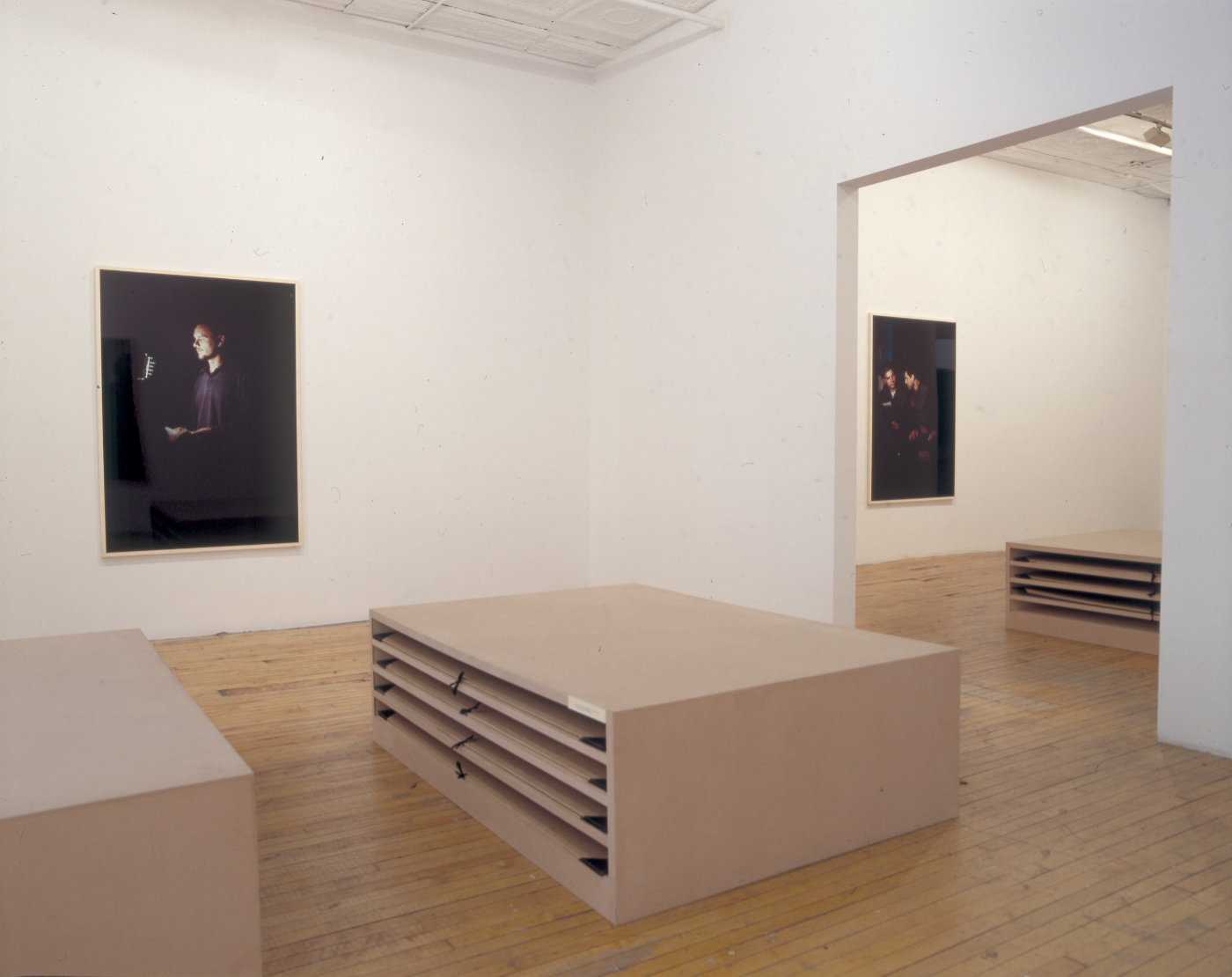
The Sick Soul IV - An Auditorium for Film, a Runway for Fashion and a Stage for Music Performance
Mamacita Fashion gallery, Mexico City 1997
For the show in Mexico City we had build a large number of wooden cubes, the cubes built by a pavement side carpenter were designed to perform multifunctional purposes for a series of event staged in the gallery. The first evening the cubes formed a pyramid like seating structure for a video projection, the second event featured DJ Carlos on a podium made of the same cubes; the third and final event was a fashion show in which the cubes were arranged to form a walkway. We had advertised in local papers a request for teenagers to appear in a fashion show displaying of their school sportswear. Confusing and chaotic as one could image each event and each experiment we conducted (inviting an old Indian lady who administered electric shocks to the visitors and us for example) each event transformed to be different and acquired a life of its own.
The Sick Soul, 1996
1. On the Borderline of Healthy Mindedness
What do you mean by the title "The Sick Soul"?
C&G: The sick soul is a term that W. James coined in his book "The Varieties of Religious Experience". The healthy minded person, according to James, is one who ignores those aspects of life which are irrational, aberrant, inexplicable and deviant. He is one who concentrates on (he normal, the rational, the law-governed. In contrast to healthy mindedness, James talks about the sensibilities of the sick soul. This type of person is morbidly fascinated with the irrational and the deviant. For him these aspects of life are deeply important and meaningful and therefore cannot be ignored.
Is it always clear to people where the law-governed ends and the aberrant begins?
C&G: The line demarcation between the two is, precisely, what separates what we currently understand from what we do not. When new discoveries are made, the line shifts. In James' time some of these shifts were quite dramatic and new scientific theories were developed in order to explain domains of the world which were formally shrouded in mystery. However, at any given time there are facts which we cannot explain and which do not conform to our general conception of the world. The healthy minded tend to ignore these facts and sometimes even to suppress them in order to preserve their view of the world. For example, the evidence that some people have telepathic connections is usually ignored because we have no theory capable of explaining the phenomenon.
What, according to James, is the difference between the religious sensibilities of the two types?
C&G: James talks about the analogy between the healthy minded scientist who ignores inexplicable facts to preserve his world view and his religious counterpart who ignores the manifestations of evil in order to follow his simple minded optimistic religion. The sick soul refuses to ignore the inexplicable aspects of life; in particular he is obsessed with questions concerning the nature of evil.
How seriously should we take the terms "health" and "sickness"?
C&G: There is no doubt that when one focuses on the irrational and the aberrant too closely one is likely to lose one's sense of reality. We are all familiar with many narratives which revolve around these phenomena. The story of Dr. Jekyll is one such example; he merely investigated the side-effects of certain drugs. Victor Frankenstein, too, was a man of the medical profession who strayed off the religious path. You can add Captain Nemo to the list of scientists who paid a high price for their fascination with aberrant phenomena. These stories were especially popular at the end of the last century.
What is your attitude towards these figures? To borrow a phrase of Kuhns, are these people revolutionary scientists who try to transcend the scientific paradigms of their times?
C&G: Most aberrant scientists never manage to cause a paradigm shift. The number of success stories is relatively small. The interest lies more in the narratives around these tragic figures, namely, with the idea that there is a gray area between the normal and the deviant scientist. Many horror movies exploit this narrative.
2. The Open Public Library
You have been recently working on a number of public projects, including the Open Public Library which you showed in Graz. These projects involved sociological research. Can you say a few words about them? Is there any connection with the subject of this discussion?
C&G: There is a connection between our discussion and these projects but it is rather roundabout. In 1989 we began to plan our first Open Public Library. The idea was to place cabinets full of books outdoors, without librarians or guards, and to see how well they will function as lending libraries. The libraries were not presented as art objects. The only indication that there was some connection with the art world was a plaque which directed people to the Grazer Kunstverein if they wanted further information on the project and, conversely, the visitors to the Kunstverein were informed that the installation continued outdoors and invited them to visit the outdoor locations. In this way we wanted to create a "flow" which tied the libraries with the art world...
What do you mean by a "flow"?
C&G: We wanted to see whether we could create a connection between areas in the social environment which are usually completely foreign to one another. More plainly, we wanted to see if we could bring the art-crowd into the relatively remote and seldom visited locations, mostly in the suburbs of Graz, where we placed the libraries, and we wanted to see whether people from the communities around the libraries were going to visit the Kunstverein.
What was the objective of creating such a flow?
C&G: We wanted to continue the investigation on the definition of art. Many people implicitly accept a rather simplistic version of the institutional definition of art. They think that relatively stable art institutions are necessary for the very definition of art. We wanted to experiment with a much looser framework. The idea was to take a non-art entity like an outdoor library and to connect to an art project without physically removing it from its non-art environment. Our point was that the necessary ingredient is a self conscience art audience and not a stable art institution.
Isn't that a rather subtle distinction?
C&G: In our times there are few stable art institutions and they tend to be privately financed and rather conservative. Our Project was the result of a train of thought about the possibility of "homeless art". We wanted to see whether art can survive without being totally dependent on stable art institutions. Our hypothesis was that the creation of a "flow" was sufficient.
How did you register the creation of a flow?
C&G: We had a team of sociology students from the Graz University who helped us gather data about the library users.
What did they find out?
C&G: The first thing we wanted to know was whether the libraries would function well. In that regard, the data was rather inconclusive. In one location the library functioned very well for the entire three month period of the project. In another location the library was vandalized almost immediately. In the third location the library was not used very much. It was quite interesting, though, that three years later, when we prepared a film about the project, we found that most of the people who we interviewed remembered the project and expressed positive opinions about it.
Did you manage to create a "flow"?
C&G: We know that there were an appreciable number of library users who came to visit the Kunstverein. But we do not have precise data.
So, you began to think of yourselves as experimental sociologists?
C&G: We began to be more interested in sociological experiments a bit later when we prepared the second library project which took place in Hamburg. This time we worked with Ulf Wuggenig and his students from Lüneburg University. Ulf told us about a body of research from the late 50's and early 60's on the sociology of everyday life which he thought we would be interested in. After reading these articles we started seeing our work in relation to the sociology of everyday life.
3. On the Routine Grounds of Everyday Activities
Can you mention a few examples?
C&G: Some of them are reprinted in this issue. We were particularly impressed by Garfinkel's "On the Routine Grounds of Everyday Activities."
What was it about the article that you found fascinating?
C&G: Garfinkel asked his students to perform elementary and unstructured experiments in their own homes. The subjects were often the student's spouse's, their children and their friends. For instance, the students came home and refused to speak. In this way they could register the anxiety they created when they ignored their everyday routines. Or, they responded to simple questions which their mates asked them with constant requests for further clarifications of the meaning of the terms used. Again, anger, frustration and anxiety were immediately registered.
So, you started thinking about your library projects as loosely structured sociological experiments?
C&G: In a way we did. We started looking for more sociological articles which had this strange existential quality and we found many more.
Which ones, for example?
C&G: Many of the more memorable ones are reprinted here. For example, an experiment where the sociologist hid in a stall of a public toilet. He sat in a stall wearing earphones connected to a powerful microphone and he used a stop-watch to time the interval between the unzipping of the pants and the beginning of the urination. In another article the experimenter stole people's garbage in order to determine what they threw away. These articles made it clear to us that there was a lot more going on with these experiments than simple healthy scientific curiosity.
4. The Candid Camera
Was that also when you started researching early episodes of Candid Camera?
C&G: That was, actually, another coincidence. At the time we met a TV producer from Munich who was working on pilot episodes for a new type of TV show. Her idea was to use auditions for TV commercials as an opportunity for creating weird situations. Something unexpected always happened and the TV crew was there to film it. We went on the set with our own equipment and photographed off-character behavior, so to speak.
Why the fascination with Candid Camera?
C&G: Candid Camera episodes constitute a form of freestyle experimentation in the social field. The early episodes, in particular, clearly stem from a fascination with the strangeness and the complexity of the network of social relations. The difference with other forms of experimentation is that the results are presented as a form of entertainment. Therefore, there was no need to deny that there was a lot of sadism and voyeurism going on, along side with the healthy curiosity.
Can you give examples of Candid Camera episodes where the similarity with the sociological experiments is evident?
C&G: There are many such examples and some images from these episodes are reproduced in this issue. Take, for example, an episode where a family is brought to a rigged bowling alley. It was rigged in a way that the wife would always win. Predictably, the husband became increasingly irritated. In another episode, a woman was ordered to leave the stage, but there was no exit from the stage. The woman, of course, became anxious and angry. These situations, like the ones studied by the sociologists of everyday life, allow the researcher to register what happens when our expectations are frustrated, when the conventions which govern our everyday life are violated.
Do sociological experiments involve as much over cruelty as Candid Camera episodes?
C&G: Some of them clearly do. Take the Milgram study of obedience, for example Just imagine being one of the experimental subjects who had to face the fact that their obedience overshadowed their moral judgment, that they administered electric shocks to human beings without any reason. At the time, the study of obedience was widely regarded as an explanation of the behavior of ordinary Germans during the Nazi period or ordinary soldiers who took part in the Mai Lai massacre in Vietnam.
5. The Origins of Generic Portraiture
But what is the relevance of this discussion to your art and art in general?
C&G: Our interest in various loose forms of experimentation in the social field allowed us to see our work, and the work of others, in a wider context. It allowed us to reformulate in a different way a recent tradition which stems from the work of the Situationists. You can locate many artists in this tradition who attempted to expand the definition of art, to frustrate the expectation of the art viewer. Artists as different from each other as Buren and Beuys, Burden and Acconci. Haacke and Walter. Ordinarily, the discourse on these artists concentrates on the performative aspects of their work. We would like to redirect the discussion. For our purposes the interest lies in the fact that these artists have managed to create interventions in the social field which allowed them to learn about the social environment. They presented their "findings" as artworks.
Why did the artists choose to rely on the art context for the presentation of their "findings"?
C&G: There is no doubt that this presentation is not ideal for communicating scientific ideas. But the information is, nevertheless, there to be found. But the advantage of using the art context is that artists don't have to deny the complexity of their motivations. On the contrary, a certain amount of self-reflectiveness is expected of artists. It is quite rare to find this type of attitude among scientists.
How do you locate your own work in this tradition?
C&G: We always felt that our portraits contained important information about the process of the representation of power, of the construction of an image of power. In our early work, we concentrated on the presentation of the basic semiotic framework. Gradually we started producing pieces which displayed some of the implicit information which we had accumulated in a more structured manner. We gathered together rejected portraits; we arranged portraits according to the intensity of the gaze of the persons portrayed; more generally, we started to look at our past work as an archive and we started organizing it in a creative manner.
Is this preoccupation unique to your work or is it endemic to portraiture?
C&G: This is the "healthy minded" side of portraiture. It is equally true, though, that portraits also involve voyeurism and other forms of morbid fascination which are somewhat independent of the information the portraits convey. In this sense, portraits demonstrate and even thematized the workings of "The Sick Soul". The portrait artist is a combination of a social researcher and a voyeur.
Can you give an example?
C&G: The best example we can think of is the work of Caravaggio. It contains extremely important information about the outward expression or characteristic physiognomy of various psychological states. In particular, the religious work of Caravaggio was deeply informed by his studies of the physiognomy of ecstasy, fear and introspection. The reason why his work contains such a powerful interpretation of the religious subjects is, precisely, because of Caravaggio's insights into the physiognomy of his characters. However, Caravaggio's paintings also display a morbid fascination with his sitters, which is independent of the general themes of his paintings. The portraits lead an independent life.
6. The Double Life of Photography
You produced a work called "The Political Physiognomical Library" in the early 90ies. Do you intend to continue producing works which are engaged in physiognomical research?
C&G: We are currently working on a new body of work which is concerned with the representation of emotions and of behavior.
Do you think of these photographs as the documentation of experiments?
C&G: We tried to move away from the academic experimental tradition. We regard the people we work with as collaborators and not experimental subjects. We work with a San Francisco based group of artists called CCSIS who collaborate with each other on their projects.
This is quite a move away from the confrontational model which you developed when you were preoccupied with commissioned portraits.
C&G: Yes. We are currently working on our interpretation of generic portraiture.
Can you say something about the graphic layout of this issue of DURCH 10 and to the connection between the magazine and the exhibition in the Grazer Kunstverein? Are they related to the general themes we discussed?
C&G: In a way they are. We wanted to transform the magazine from a collection of documents into an exhibition space and to transform the space of the Grazer Kunstverein into a library of images. We wanted to make it possible to look at the same material from different points of view. We wanted to present the academic texts as scenes from a strange existential theater, the episodes of Candid Camera as the work of aberrant scientists and our own work as a combination of both.