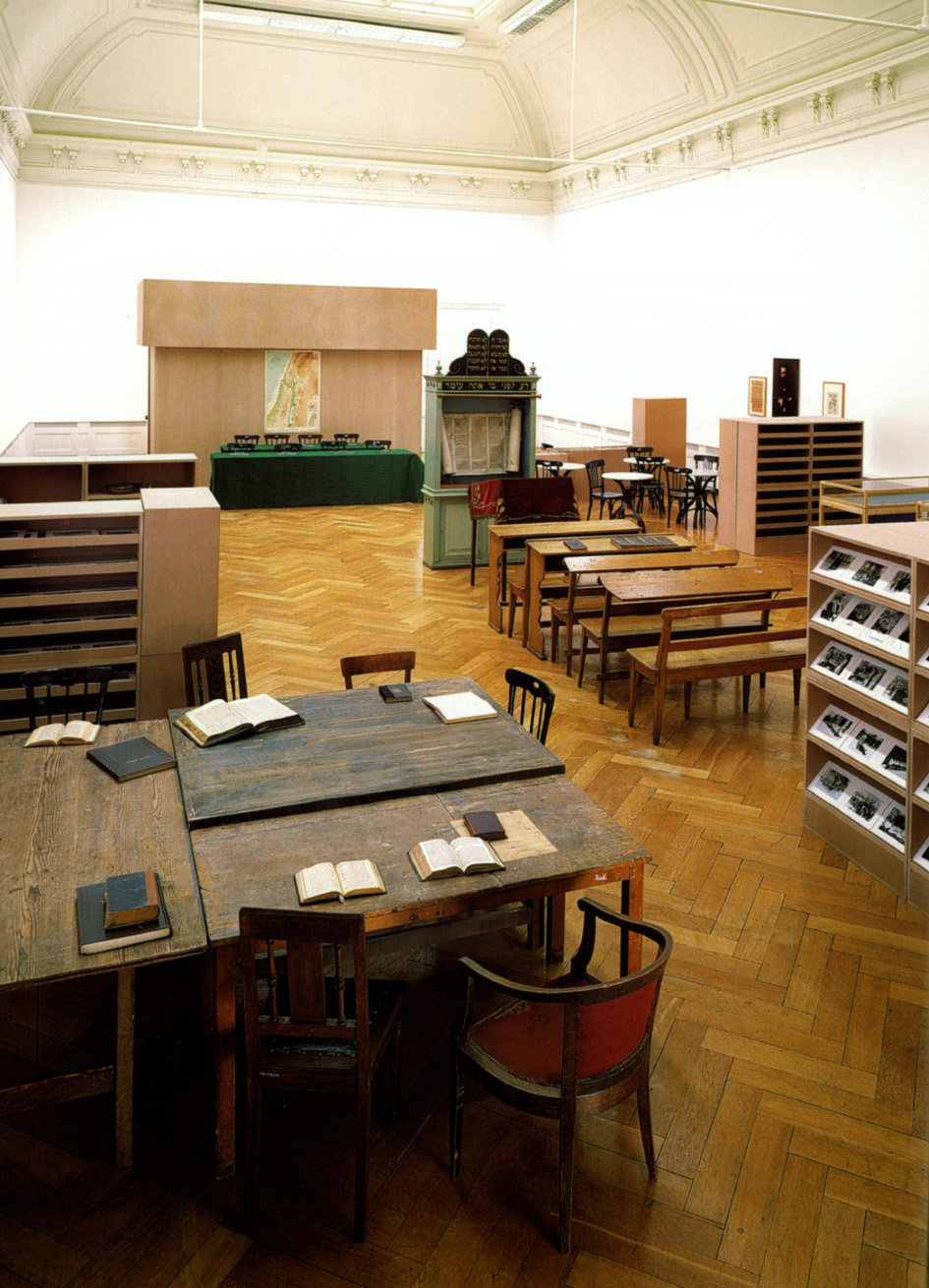
1897, The First Zionist Congress
Catalog text for the show at the Basel Kunstverein 1998
1. The Exhibition: History and Reflection
The exhibition "1897, The First Zionist Congress in Basel" is a collaboration between Professor Haumann from the University of Basel and a group of historians of Zionism, along with Clegg & Guttmann, a team of artists from Israel (who now live and work in the United States).
The show operates on two levels:
- A historical exhibition centered on the pivotal event of the first Zionist Congress in June 1897.
- A meditation on the concept of a historical show itself.
We aspire to present the historical material compellingly while drawing attention to the methods and devices used in its construction. The exhibited objects are typically archival material, "unearthed" and brought together to make a coherent story accessible to the public. We believe the mode in which this process is effected deserves critical attention and reflection, as the construction of history is too important to be treated uncritically.
2. On Curating Historical Shows
The basic elements of a historical show are documents, photographs, and souvenirs. Sometimes works of art and furniture are added. Curators often try to exhibit objects with an independent aesthetic value to serve as a "lure" for viewers, encouraging them to invest time in the more challenging parts of the exhibition.
While this aesthetic strategy has justification, particularly when the historical subjects themselves produced artful objects, the question remains: Do we need to feel apologetic about presenting meaningful "pieces of life" without obvious aesthetic value to gain a better understanding of past events?
- Historical exhibitions must appeal to the visual and the immediate organization of material, different from a book presentation.
- However, we believe an object becomes important the moment we make it the focus of attention.
This urgency is heightened when trying to conjure the historical memories of people, like the first Zionists, who represented themselves primarily through spoken and written words (discussions and arguments). When we invite you to immerse yourself in the environments where the first Zionists read, wrote, and debated—the Heder, the café, the synagogue, and the parlor—we do so without relying on the rhetoric of the "important object."
3. The First Zionist Congress: A European Event
In the summer of 1897, a group of young Jewish individuals—English, Russian, French, Germans, and Austro-Hungarians, many in their twenties and thirties—congregated in the Stadtcasino of Basel.
The main agenda was the ambitious plan to create a secular Jewish state. The meeting was a success, leading participants to believe a new sense of secular Jewish identity, based on a life-sustaining idea, had been born. They were right: 51 years later the state of Israel was declared in 1948, and the first Basel congress was the seminal event in that process.
Herzl and Identity
While the Zionist congress led its followers to the Middle East, the congress itself was an European event par excellence. The main organizer, Theodor Herzl, a Viennese dandy and Paris correspondent, conceived the idea in 1895. He wrote his pamphlet in a state of trance, listening to Wagner and walking in the Tuileries.
Herzl wrote: "The promised land... no one has ever tried to look for it where it really is deep inside us... the promised land is where we want it to be... a land where we will be permitted to grow down turned noses, black and red beards and crooked legs without being scorned... where we can live like free men on our land... where the derogatory term Jew will become an honorific term on the same footing as English, French or German."$^1$
This sentiment echoes today. Replacing "Jew" with any other marginalized group and the visual insults with any racist idea gives, in a nutshell, the grounds for the separatist vision encapsulated in any form of identity politics. This is the impetus behind confronting the misery of feeling one's birthplace is not one's home.
4. Background: The Revolt Against Reason
The Zionist movement emerged against the background of a monumental shift in European consciousness: the erosion of the Enlightenment ideals.
- The Enlightenment held that the world was open to rational understanding and that reason could lead to a just government.
- It was in the name of enlightened universalism that the Jews were emancipated in Europe.
The erosion of this belief directly impacted the stability of Jewish emancipation. Although liberal democratic ideals seemed solid, everything changed dramatically in the 1880s and 1890s, which was the background for the emergence of the Zionist idea.
The Rise of Anti-Semitism and the Culture of Denial
The last two decades of the 19th century saw a violent assault on rationalism and liberalism (e.g., Anarchist terror, the Panama Canal scandal in Paris). Corresponding to each outburst was a growth of anti-Semitic sentiment.
The assimilated Jews, often the only ones faithful to the Enlightenment spirit, developed a culture of denial, quietism, and self-hatred:
- The vast majority of West European Jews refused to acknowledge the gravity of anti-Semitism.
- Those who did often blamed themselves for not trying sincerely enough to assimilate and "lose their Jewish-ness."
- Attempts to "pass for non-Jews" were met with scorn by non-Jewish neighbors.
Zionism as a "Realist" Movement
The Zionists recognized the inevitability of anti-Semitic sentiment and the futility of attempts to ignore it. They despised the culture of denial.
- Zionism was a "realist" movement aiming to counter the tendency among Jews to repress and obscure their perceptions.
- In their perception that anti-Semitism was ingrained, the Zionists also contributed to the erosion of the liberal democratic spirit and the "revolt against reason."
Zionism's Twofold Aim
The primary aim of Zionism was to create the conditions for Jews to finally look at themselves without self-censorship. While Herzl saw Zionism as an answer to anti-Semitism, others, like Gershon Scholem years later, saw it as an aspiration for spiritual renewal:
"What influenced me was the undercurrent which emphasized the creation of a condition which would make a self-reflection of the Jews of their own culture and history possible and aimed at a spiritual, cultural and social renewal."$^2$
This combination of confronting hatred from without and anticipating a spiritual revolution from within made Zionism extraordinarily effective. This twofold aim is a defining characteristic of many modern "identity politics" movements.
5. The Birth of a Nation
Herzl's analogy in the fall of 1897, on the occasion of Hanukkah:
"First, one candle is lit. Alone, it cannot defeat the darkness, and its solitary light seems melancholy. Then, another light joins in and another and another. Finally, the darkness must recede... No labor brings about so much happiness as work at the service of the lights."$^3$
- A single person speaks the language of personal misery.
- When others join, a collective entity is born, and wretchedness gives way to collective pride.
When the collective aims to transform the social fabric, it is revolutionary. When the primary goal is to separate itself from its origins, a new nation is born.
Phase Transition
The logic of separatism strongly encourages the formation of a new country and the adaptation of a new national language. When this process succeeds, it is akin to phase transition in physics: aimless individuals, through faith in their associates, give rise to a new, coherent whole—a "social crystal."
It is easy to forget that in the beginning there were only separate individuals. The secret lies not in a secret nature they discovered, but in their willingness to believe there is enough that is similar to counter the differences.
6. Zionism and Identity Politics
Placing Zionism in the lineage of identity politics offers two insights:
Reflection on the European Context
At present, xenophobic sensibility has considerable acceptance in Europe (e.g., the slogan "The Boat is Full"). We must remind the European audience of the bigoted legacy of Europe and the fact that there is little real tolerance for differences even today. Zionism was the result of Europe's failure to allow a "model minority," the Jews, to assimilate.
A Remark to Practitioners of Identity Politics
Zionist history is a case study that reminds newer movements of the dangers inherent in identity politics.
- Zionism started as a sincerely Utopian solution (Herzl thought it could apply to American blacks).
- Later, it helped the creation of a new Palestinian nation fighting for national rights on similar principles.
A key theme that emerges is the rejection of the present situation. This negative mentality raises a systematic problem: leaving one situation always means entering a new one with its own problems.
The world has no vacuum. When you migrate from one location you always move into someone else's territory.
Herzl and his associates were documented as being not very preoccupied with the issue of relations with the local Palestinian population.
7. The Power of the Visual
So much of the message of anti-Semitism is expressed in visual language (facial expression, physiognomy). Consequently, many Jewish self-attitudes were tied to their self-image.
- Assimilationism repressed the awareness of one's appearance and did not produce a culture of portraiture.
- Zionists negated assimilationism, creating an immense awareness of the power of photography to create new Jewish icons, but concentrating on the visionary and mythical.
We seek to shed a new light on the early Zionists—the generation of Proust, Freud, Kafka, Kraus, Mahler, and Schoenberg—to regain access to their memory.