Mach versus Boltzmann
Spatio-temporal construction in eight parts or Composition for early modernist cognitive exercises
An Introduction
The present exhibition at the Secession in Vienna is an ideational construction - to use Mach's terms - having the form of a spatio-temporal composition with eight parts or, from another, Boltzmannian point of view, sequence of early modernist inspired cognitive exercises designed to further the cause of cognito-emotive reconciliation with the chaos, dissonance and discontinuity typical of the environment of the modern metropolis.
The exhibition is conceived of as concrete score, the different movements of which must be performed in order to be experienced aesthetically; some are individual or solo parts others, orchestral arrangements to be carried out in groups. The different elements of the installations are also games, embodying various conceptual revolutions associated with early modernism, inviting the viewers for intellectual self-reflection on the nature of their cognitive system, coordinated with bodily engagement.
The focus is on the cultural developments associated with the emergence of the modernist movement in Vienna in the 1890's and the 1900's. The two ways of looking at the installation correspond to a major division in the modernist camp, namely, the opposition between the philosophical views of Mach and Boltzmann, the main protagonists of the present project. The presentation highlights the opposition between the two physicists and philosophers of science, both of whom taught in the University of Vienna, treating it, both, as historically central narrative and, crucially important philosophical distinction between two types of modernist ideology, each invaluable for understanding the intellectual tenor of the period. Mach's phenomenalist approach, which placed the experience of individuals at center stage, defined the anti-metaphysical and anti-mechanical temperament of the fin de siecle, shared by positivists and expressionists alike; Boltzmann's statistical view, on the other hand, divorced mechanics from the bourgeois metaphysics of law and order, replacing the latter with chaotic and anarchic ethos, instead. The two positions and the opposition between them were given different formulations that demonstrated the relevance of both in aesthetic, ethical and cognitive contexts; indeed, it seems that understanding the two philosophers provides a major key to many perhaps most of the controversies of that eventful period.
From yet another perspective, the present installation constitutes an act of self-reflection on its own cultural and intellectual context. Indeed, more than any other cultural organ, the Secession represented the spirit and sensibilities of early modernist Vienna and thus, anyone mapping the fin de siecle consciousness of the Austrian-Hungarian capital, is engaged by implication in a reflection on the nature of the Secession and, its intellectual underpinning. One might say then that the project investigates the 'deep structure' of its own cultural language, reflecting on the conditions of its own cultural possibility. The questions underlying the project, in other words, concerns the origins of the concept of art behind it and thus it is positioned firmly within the boundaries of conceptual art.
But the installation is, first and foremost, historical drama of a new kind, animated presentation of the emergence of the early modernist philosophy, by all accounts a highly significant episode of Viennese intellectual history. In this drama the Secession played a leading role; it was embodiment of the Machian position par excellence, philosophical expression of the spirit of the alienated educated middle classes. After the rise of mass politics, the liberal democratic parties lost their political mandate; their position in the political life of Austria became marginal and in their place emerged the socialists, Christian Democrats and German nationalists. The loss of social relevance was experienced individually as sense of alienation. Consequently, instead of political engagement the educated youth of the turn of the 20th century invested their considerable talents, energy and resources in culture, instead. The departure from society was expressed in philosophical terms as radical subjectivism and individualism.
The Secession was a product of this spirit of social alienation, announcing its sensibilities in the choice of a strangely incongruent pagan temple as its home. The present exhibition pertains to this history, providing tools for understanding the graphic, architectural and institutional aspects of this extraordinary exhibition space and the artistic sensibilities of Klimt, Schiele, Hoffman and others who developed their artistic language in the context it provided. The historical reflection and its relation to the present are aided with a collection of video-tapes displayed in the exhibition where texts by Mach, Boltzmann, Weininger, Kafka, Musil, Kraus, Loos and other early modernists are read by contemporary Viennese cultural producers.
Ours is a period of confused identities, ambiguous political sensibilities, lack of strong cultural drives. A hundred years or so after the beginning of modernism we find ourselves deeply uncertain about what answers to give the most basic questions of ethics, aesthetics and politics. The existing ideologies seem unsatisfactory, leaving too much unsaid, the cultural agenda, conflicted and inconclusive. Perhaps an act of self-reflection on the origins of the current state of affairs might bring us closer to an insight concerning our identity thus providing us with invaluable tool to investigate where to go next.
Cognitive Exercise #M1: Unstable Equilibrium or The Prisoner's Dilemma
A two-person game
The Game
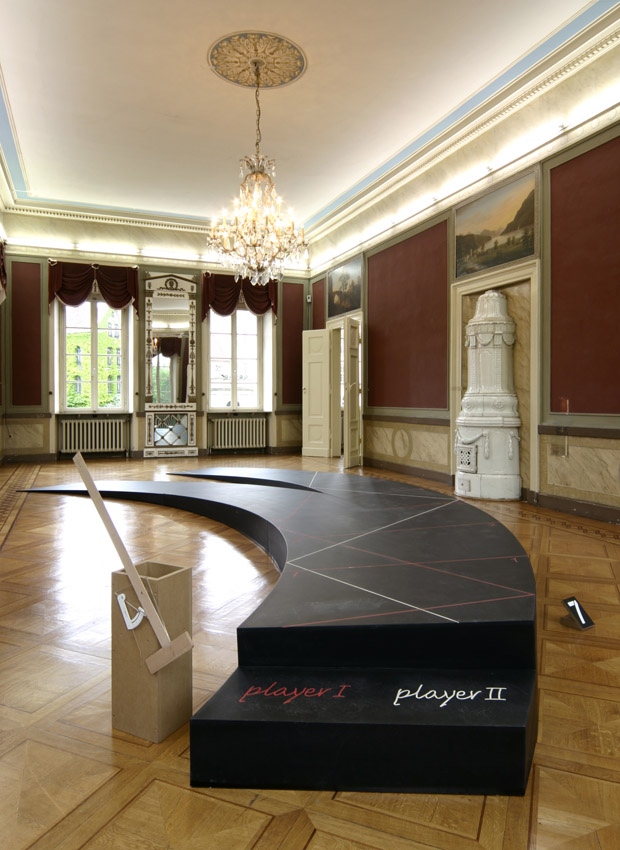
Two blindfolded players, identified as the Column Chooser and the Row Chooser, stand in front of their two respective options in the Game Matrix Platform. Upon receiving a signal each moves in front of the 'box' decided upon (Left or Right in the case of the Column Chooser, Up or Down for the Row Chooser.) When both players make a choice they untie their blindfolds and place a flag in the position they arrived at jointly, obtaining their respective payoffs represented by the four pairs of numbers on the game board. The position Up-Left corresponds to the payoffs -1/-1, Up-Right: 0/-8, Down-Left: -8/0, Down-Right: -8/-8.
Introductory Remarks
The Prisoner's Dilemma is a strategy game for two players: the Column Chooser and the Row Chooser. Each of them must decide between two options without knowledge of their opponent's decision. (The players are initially blindfolded in order to ensure the independence of the decisions.) A pair of simultaneous choices determines a position. Each position determines a payoff, represented by two numbers, one for each of the players. Each player aims to advance to the most advantageous position, namely, one where his payoff is maximal or minimal depending on the nature of the situation. The game requires the players to develop competitive strategies, whereby their vicissitudes are intertwined -- the decision of one influencing the payoff of the other.
The game is represented by a 2x2 matrix, where each of the entries represents a pair of simultaneous choices -- i.e. one box in the matrix corresponds to each possible combination of column choice and row choice. The following matrix corresponds to the Prisoner's Dilemma: Column chooser: Row chooser: -1/-1 0/-8 -8/0 -8/-8
The Prisoner's Dilemma
An example of the situation corresponding to the Prisoner's Dilemma regards the decisions of two criminals caught after having committed a crime together. As the evidence against them is circumstantial and sketchy, each faces a dilemma. They may refuse to admit to the crime, in which case each of them faces a year in prison. Alternatively, each may confess, aspiring to become a state witness and be pardoned, hoping the other does not do the same. If one confesses and the other does not, the state witness is released and his partner is imprisoned for eight years; if both confess they each receive the maximum sentence. Obviously, the two should refrain from confessing and face only one year in prison -- relatively lenient punishment. Knowing this to be the case, however, each might still try to do even better and become a state witness instead. The situation is, of course, perfectly symmetric and so each knows that the other faces a parallel dilemma; in other words, each knows that if the other thinks the same way he does and acts on this thought, they will both face an eightfold prison sentence. And so, having contemplated the possibility of betraying their friend, they may reconsider the strategy and return to the option of not confessing. Knowing, however, that the other faces precisely the same dilemma and so is reconsidering betrayal, each player faces the same dilemma as before once again; he is, in a word, again thinking of betrayal to outsmart his partner-opponent. In conclusion, even if both ought not confess, they are unlikely to arrive at that position in the game; both are more likely to choose betrayal, instead, and so be punished severely. They act against their self interest by trying to outmaneuver one another.
Unstable Equilibrium
The Prisoner's Dilemma is a game where one of the positions is preferable to both players, namely, a game with a point of equilibrium. This superior solution, though, is unstable; once there, both players have reasons to divert from it. Speaking abstractly, the situation is reminiscent of a ball standing on the tip of a mountain, where the slightest pressure is sufficient to send it downwards. Strictly speaking, the ball might stay on the tip but it is highly unlikely to do so. Positions of this kind are called unstable equilibrium.
Symmetry Breaking
A theoretic problem that arises in relation to the notion of the unstable equilibrium is known as symmetry breaking. Once the situation destabilized, the fragile equilibrium broken, what 'chooses' the direction of the deviation from it? How is the departure from the unstable equilibrium determined? How, in other words, should we model unstable systems of this kind mathematically?
The questions bring to mind the story of Buridan's mule, which remained motionless and died of hunger because it was unable to choose between two identical loads of hay placed at equal distances. One wonders whether, analogously, not being able to 'decide' where to go, the ball remains 'paralyzed'; indeed, does the absence of sufficient reason to depart from equilibrium in any particular direction keep the ball standing on the tip of the mountain? Does symmetry introduce 'second order stability'?
Obviously, the answer is no. Balls do not stay on the tip 'out of respect for symmetry' any more than mules that do, die of hunger. Nevertheless, the problem of symmetry breaking is a puzzling one; when the reason for departure from unstable equilibrium is not presumed to be the 'decision maker' -- as is the case with a ball on the tip of the mountain that drifts down because of variations of air pressure, gusts of wind, deterioration of the soil etc. -- how do we explain the breaking of symmetry?
The first to demonstrate that symmetry does not imply second order stability was Leonard Euler. In 1714 the German mathematician analyzed how struts buckle right or left because of weight placed on top. The phenomenon of sudden symmetry breaking is known as bifurcation. Deterministic laws of motion that allow seemingly paradoxically multiple solutions correspond to such cases. A fork in the road is fixed in advance where the system has more than one option from which it must 'choose'. There is nothing random about such systems; the determination of the choice of the direction of the system is presumed entirely dependent on physical parameters. And yet, it is often beyond the powers of scientist to calculate in advance how the system will develop.
Catastrophes
The buckling of struts, sudden bending of weighted flexible rulers either to the right or left, and the snapping of rubber bands upon over-stretching are examples of mechanical systems undergoing catastrophes. Examples of this kind demonstrate that thresholds might be traversed for natural and immanent reasons. Euler, as mentioned, started mathematical inquiry into these issues, but it was Henri Poincare who systematized the research at the end of the 19th century and underlined the philosophical implications of the possibility of catastrophes in nature.
One of the strongest and most persistent beliefs about the physical world is that 'nature does not jump'. Objects do not vanish suddenly from their position and reappear later in another. We believe that spatio-temporal discontinuities do not occur in nature. For many centuries it was taken for granted that, in addition, physical systems do not change their tendencies or dispositions in sudden unexpected ways. What seems unexpected to humans is not objectively so. An omniscient being could always find rhyme and reason behind sudden shifts of direction, and do so ahead of time. Thresholds invariably reflect perceptual insensitivity. Those who cannot register minute details observe sudden jumps once their sensitivity thresholds are traversed; behind this, though, there was always some gradual build-up before the transformation took place. Abrupt reversal of direction -- kink, fold or sharp turn -- do not and cannot be given objective meaning. This belief was at the very core of the classic conception of mechanics.
The rejection of the idea that natural deterministic processes always develop gradually was expressed in the following passage of Poincare's seminal article 'Chance' that appeared in his book Science and Method of 1903:
A cause so small that it escapes our notice determines a considerable effect which we can not fail to see... even if it were the case that the natural laws no longer had any secrets for us, we could only know the initial situation approximately... it may happen that small differences in initial conditions produce very great ones in the final phenomena.
Deterministic chaos, according to Poincare, was not a contradiction in terms.
The existence of catastrophes in physics, sudden departures from equilibrium in a direction no one can fathom, was a genuine conceptual revolution, one of several that took place in the 1890s, establishing various conditions of possibility for modernist thought, reconciling what previous generations of physicists and philosophers deemed contradictory notions. The cognitive exercises in this exhibition allude to different conceptual revolutions from the same period.
The present exercise concerns the reconciliation of determinism and chaos by demonstrating that deterministic systems might engender unforeseeable events with no sufficient reason. Determinism, you may note, was presumed until the end of the 19th century to rule out not only multiplicity of potential futures but also developments without sufficient reason. Catastrophes and other events involving abrupt symmetry breaking were thus considered anathema to natural regularity. Such events cannot be conceived of as the unfolding of fixed tendencies previously instated. In other words, the very idea of law-governed phenomena had to be reformulated; continuity and determinism were demonstrably consistent with abruptness, lack of sufficient reason and unpredictability. Nature admitted catastrophes.
The Alleviation of Anxiety
The social processes that brought modernism to Europe were themselves catastrophic processes; they proceeded in what seemed an arbitrary, chaotic and unpredictable manner, destroying the former habitat and bringing about an environment seemingly fragmented, void of coherence and lacking harmony and regularity. If beauty reflects a sense that the world is well adapted to man's cognitive faculties -- displaying recognizable symmetry, regularity of features and harmonic organization -- the chaotic and incomprehensible nature of the modern environment seemingly ruled out the very possibility of aesthetic pleasure. In other words, the appearance of catastrophes implied not only incomprehensibility, but the disappearance from life of the aesthetic dimension in toto. Furthermore, the constant fear that 'out of the blue' developments might occur involving malign new forces yet to be understood that are abrupt, destructive and unexpected, generated anxiety in the population of cities like Vienna on a large enough scale to make it a serious public health issue. The problem was wide-ranging and urgent; many were 'cracking up', 'snapping' under the intense cognitive strains the changes of the environment brought into their lives. Modernism was conceived of as the cultural means to combat the anxiety -- a reintroduction into the environment of new comprehensible order. It was to facilitate new projections of regularity into the external environment of a markedly different kind. Indeed, the new sense of order and regularity necessitated various conceptual revolutions; terms had to be redefined, their meaning expanded. Poincare's ideas about instability were an example, vital prerequisites of the new notions of order. Chaos, in particular, did not stem from an inner failure of cognitive organization, but reflected objective processes in the external world. It was not evidence of shadowy disruptive force but physical law of a new kind. This was one of the first steps necessary in order to alleviate fin de siecle anxiety.
Cognitive Exercise #M2: Curve Fitting and Boot Strapping
A cooperative game for a small group of players
Instructions
A small group of players gathers around a mechanical piano. One must operate the lever of the instrument and the rest listen carefully to the music trying to cull from harmonic patterns, regular rhythms or any other structural property of the 'bundle of sensations'. These should be notated in any symbolic representation the player see fit and transcribed with chalkmarks on the track around the piano. Afterwards the participants perform the score, interpreting the music, viewed in its relation to their notations, with 'symphony of bodily movements'. The exercise is then a collective interpretative exercise, culminating in creative communal composition for bodily motions. This is a creative exercise in the pre-jazz meaning of the term; in the turn of the 20th century notations were still considered central to the creative act, earning for it the status of ideational construction. There is yet no acknowledgement of the possibility of improvisation based aesthetics, syncopation, (see cognitive exercise #B2) was still relegated to ragtime music, a mass-entertainment form, removed in every way from the refined, serious and rigorous spirit of the Viennese modernists, the aesthetics we associate with Ernst Mach.
The Bootstrapping Game
Bootstrapping is a communal cognitive exercise for an impromptu 'orchestra' -- a group simultaneously performing intercorrelated acts. The players are exposed to musical stimulus -- a heterogeneous bundle of incoming sounds originating from a mechanical piano-roll. They embark on a collective interpretative project, namely, an attempt to comprehend, translate and 'perform' the stimulus. They identify a structure or formal core in the incoming sounds and use it as the basis of a score for another time-based medium, which they then realize together. As they listen to the incoming sounds, the players must find rhythmic and harmonic regularities, which they transcribe and then perform. First, they must fix a vocabulary -- signs to be inscribed on the floor board, each associating particular physical movements or action with an aspect of the sound. Having done so, they begin constructing interpretative analog sequences. They output 'sentences' made of the 'words' available to them, threading the 'sentences' into 'phrases' in the language of the actions of the body, while retaining the original formal patterns, lifted from the original stimulus intact.
Once the players find rhythmic and harmonic patterns in their respective sources, they gain the ability to anticipate what is about to come next. (True comprehension of rhythm and harmony always implies the ability to follow the musical rule, namely, to predict the next elements of the sequence, and even join the source with analogs of one's choice.) First, the players set themselves to a constant rhythm expressing it as a regular pattern of movement; then they begin comprehending, predicting and realizing various harmonic patterns as well, superimposing on earlier ones each new pattern of movement they invented on the basis of laws they abstracted from the sound. The group thus begins dancing together to the music, jumping, turning sideways and adding further modulations and rhythmic patterns with their arms and upper body as embodiments of those they found. Together they can perform the total audible stimulus, giving to it the form of a multi-player composition for bodily movements.
The Machian Spirit -- Introductory Statement
'Curve Fitting and Bootstrapping' is an exercise inviting the player to find the general laws of empirical data -- patterns and regularities 'hidden' therein. The input is a sequence of musical sounds, the source -- a mechanical instrument 'playing' from notes etched on a cylinder. The objective is to determine the rules of organization of the sequence on the basis of limited and partial information based on particular instances. Using the laws, predictions can be made concerning the continuation of the sequence. In short, after listening for a while the players try to transcribe and analyse the music using a system of notation invented for that purpose. This is a simple illustration of the process of the construction of a theory, facilitating predictions, on the basis of observations.
Mach formulated the fundamental maxims of such theoretical activities. Ideational constructions, according to him, should be simple, economic and transparent to the extent possible. Simplicity implied that the law of the sequence should relate the greatest number of aspects of the sequence in the simplest way possible. The principle of economy recommends using only what is absolutely necessary for prediction, omitting everything else. Transparency means that the regularity found in the sequence should seem a natural phenomenon, inseparable from the sequence itself. Of particular importance to Mach was the prohibition against postulating the existence of entities or theoretical objects that cannot be directly observed. He regarded the predisposition to do so fetishistic and ornamental, two tendencies he associated with the bourgeois mentality of his time. Unobservable objects, he argued, don't have any potential explanatory value and thus postulating them contradicted the economy principle. Unexpected insight -- a new aspect of familiar object -- necessitates empirical observation; nothing new or unexpected can be gained about objects postulated by decree. And so, why bring into theories un-useful entities of this kind, ones as lacking of empirical content as the "object-as-such", the metaphysical subject, God etc? The case at hand illustrates well the cogency of Mach's theoretical position; if the sole purpose of the player is to predict the incoming sounds why postulate special entities which one cannot hear or see in order to do so? Could such entities facilitate musical comprehension?
Mach thought that Boltzmann's atoms belonged to the same objectionable category, and violent controversy on the topic ensued, dividing not only the Viennese intelligentsia but also the entire world of science and letters. In 1905 Boltzmann emerged a winner; the experiments of Perrin and the theory of Brownian motion by Einstein provided enough evidence to convince scientists of the existence of 'invisible' molecules and atoms of matter. Nevertheless, Boltzmann committed suicide a year later in Luino.
Bootstrapping concerns the Machian conception of science; it exercises the ability to find laws, patterns, rhythms and regularities in a stream of incoming stimulus. The players are to use Mach's Principles of Mental Construction to guide their efforts.
Musical Comprehension as a Form of Self-Construction
The Bootstrapping game is primarily an exercise of the ability to construct formal laws, or other analogs to given stimulus, on the basis of abstraction. Even if the project involved is communal, here we are concerned mainly with a combination of individual processes rather than genuinely collective projects; the latter are revisited in other cognitive exercises.
One of the purposes of the game is to demonstrate the plausibility of Mach's thesis that the self was an ongoing construction rather than a fixed entity. As you may recall, Descartes' 'I' was thinker of the thoughts present in the mind, and Kant's, source and author of their unity. As such, the 'I' is, and must be, the sum total of the cognitive and emotive dispositions implicitly used to find rules and regularities in the stream of impressions. But the dispositions to find patterns and rhythms are not buried whole in the mind but developed in relation to incoming impressions. As Wittgenstein observed late in life following a rule is essentially an ill-defined affair that does not lend itself to any sense of closure; indeed, who knows how one might react to a new incoming stimulus? And thus, according to Mach, exercising the ability to find laws in the phenomena is, in very real sense, a self-constructive process or, in a word, Bootstrapping.
The Machian Weltanschauung
In order to better understand the gist of Mach's conception of the theorizing activity we shall end with few general remarks on various notions that illuminate his general point of view.
(i) The Stream of Thought
Imagine nothing beyond appearance, neither supersensible nor substratum, that nothing whatsoever exists, except an ever flowing stream of thought, smooth bundle of impressions tirelessly unfolding, admitting neither gap nor overlap. The manifolds Elements, soft 'building blocks' with little core and much fringe, all inter-penetrate, striving to reach beyond the range, to 'loosen the cage'. Ever rhythmically inclined, eagerness and cognitive hyperactivity fueled part anxiety, another, practicality, the stream is slave to one master and one master only -- beat from within pointing the way forwards.
(ii) Space
Space is not another inner beat but what Wittgenstein called a net in the Tractatus -- a systematic descriptive framework expressing and organizing a family of relations. (In the geometric case we have the relations -- p stands to the left of q, p is to right of q, p is below q, p lies above q etc. The color space systematize the relations -- p is brighter than q, p is darker than q, p is the superposition of q and r etc.)
(iii) Objects
Objects do not exist except as semi-invariant bundles of properties and relations. In other words, whenever we discern in the flux of things a set of interrelated properties and relations that remain seemingly unchanged relative to a shifting background, we tend to extract them from the context and introduce the assumption that the relative invariance observed reflects the permanence of an independent self-sustaining object. Behind the inclination is a fetishistic mentality, an ancient tendency to endow man-made idols and gods with supernatural powers of their own. The decision to call a relatively invariant set of relations object must be given pragmatic justification; deeming an artificial construction independent reality must be demonstrably useful to overcome the obvious objection that doing so invariably goes counter to the actual facts of the matter.
The Convergence of the Scientific, Ethical and Aesthetic
From a scientific point of view the principle of economy of thought is a plea to retain the distinction between fact and artifact, observation and speculation, passive receptivity and personal preference. These distinctions were not only the basis of the scientific approach, but the very foundation of bourgeois individualism, according to which, the world should be divided into public inter-subjective domain of fact and personal subjective individual sphere. By Mach's time the distinction between the sphere of fact and the realm of individual preference had been eroded; the proud, honest and industrious bourgeois of the early 19th century metamorphosed into hypocritical, self-indulgent and egotistic specimen a half century later. Indeed, Mach's was a critique of bourgeois morality in the name of its original calling. The early modernists of Vienna were united in their conviction that if democracy, when properly understood, necessitated more radical changes than anticipated, so be it.
Initially, little genuine revolutionary spirit informed the milieu of the early modernists; they merely sought a more open and less censorious code of conduct. The very same guidelines involved in the principle of economy had, in fact, clear moral implications; general, simple and transparent construction is also one where the narcissism responsible for cultivating personal idiosyncrasy is held in check, and where intentions are given honest formulation that stand allows them to be communicated clearly to others.
In Kant's system the aesthetic judgment was anchored in the concept of form. A distinction was made between gratification and pleasure where the latter, though subjective, was void of any trace of dependence on interest or peculiarities of sense and thus deemed universally valid. The concept of form thus both informed the social sense and depended on it. Aesthetic judgment gave content to the notion that agreement on formal matters can be expected from 'anyone deserving of the name man'. Vice versa, a Kantian concept of 'cognitive community' was derived on the basis of common formal sensibilities.
Mach rejected form as any other synthetic a priori truths. The latter, in his mind, were mystifications reflecting confusion between fact and subjective disposition. Nevertheless, the principle of economy of thought provided a substitute to the notion of form inheriting certain aspects of its role in the Kantian system. Different subjects each adhering to the principle of economy might be able to communicate on that basis; lack of ornamentation, transparency of structure and clarity of intention thus pointed exactly in the same direction substantiating the new social sense of the modernists, namely, expression of the affinity of the alienated and self-enclosed.
Cognitive Exercise #M3: Analysis and Synthesis of Sensations
A game for a single player
Instructions
The present game invites the participants to analyze an object and its properties -- more specifically, the bronze sculpture presented on the Large Pedestal. The method of analysis is based on series of comparisons of the sculpture with other objects. Inside the hull of the pedestal is a collection of objects -- small toys representing animals, instruments and household objects, geometric shapes, colored strips of paper, cardboard cards with words, cutout numbers etc. Each round, the player picks out an object 'randomly' from a slot in the pedestal and compares it to the sculpture, trying to discern something common to both-- identifying, in other words, a shared property or, in Mach's terminology, similar sensation invoked by each of the two objects compared. The player is then required to specify explicitly the category used in the comparison and write it down on the blackboards prepared for that purpose on top of each pedestal -- 'same color', 'same shape', 'similar features' -- for example.
The game board -- a large wooden cutout on the floor -- determines the game sequence; (it is an enlarged reproduction of Network of Stoppages from 1914 by Marcel Duchamp.) The board spans a tree structure the player tries to 'climb', until reaching a terminal point at the 'top'. The junctures of the tree are labeled numerically from right to left -- according to their level and their location on each level. (The rightmost branch on the first level of the tree labeled '1', the one to its left '2' etc., the branch furthest right, splitting from '1' is labeled '11', the second '12', and so on.) At each juncture is a pedestal with the same numerical designation.
After picking up the first 'random object', the player places it on Pedestal No. 1 -- on the far right -- and, if successful in identifying a property the chosen object shares with the sculpture, the player writes down the relevant category on the pedestal, and proceeds straight ahead, placing the second object picked at random on Pedestal No. 11. On failing to find a common attribute, the player must move laterally, placing a new object on Pedestal No. 2, instead. Generally, after a success the player moves upwards and following a failure, sideways to the left. The game ends when the player reaches one of the terminal points on the board (winning) or, alternatively, when no lateral moves are available (losing). The number of stations the player went through, on the way to the top is the score; obviously, the lower the score, the better.
Remarks on the Game
Analysis and Synthesis of Sensations is a game designed for single players, focusing on cognitive processes of individual subjects, thus embodying the psychological point of view, associated with Ernst Mach, leaving collective 'Boltzmannian' concerns, arising in other exercises, temporarily suspended. In this game the object of the analysis is the manifold of sensibility (or, bundle of sensations,) corresponding to a designated object. The method employed reflects Mach's theory of the mind; it consists of isolating various aspects thereof and investigates the respective contributions of each to the whole. Indirectly, the method also pertains to a domain of cognitive processes of which, according to Mach, ideational construction or synthesis normally consists.
The game begins once the player observes the object presented on the Large Pedestal; doing so invariably engenders in the mind sensations of various types -- visual, tactile, auditory etc. -- initially presented in unarticulated or bundled form. The analysis of the bundle of sensation is the process whereby the observer disentangles each individually, thereby comprehending it, until all aspects are attended to, in which case the player is said to comprehend the object, itself.
Clearly, the observer must focus first on an individual aspect of the bundle of sensations; separated from the rest, its contribution to the whole might be articulated. The analysis proceeds by varying this aspect of the manifold, while keeping others constant; using his or her imagination, the observer constructs new hypothetical manifolds, identical to the original in every respect, except those varied. Next the player contemplates the impact of the variations on his or her cognitive state as a whole, asking what would have been different if, instead of the actual bundle of sensations, the imaginary one were obtained in its place. The differences between the original manifold and the variations thereof so obtained reflect the systematic contribution of the aspect in question to the bundle as a whole.
Engaging in the process of analysis, then, the observer disentangles individual groups of sensations, thereby decomposing the bundle, creating for it a 'tree' of imaginary cognitive alternatives. Each node of the tree characterizes, hypothetically, what would have been one's cognitive state without having obtained a certain aspect of the manifold of sensations. What, for example, is the contribution of the color of the sculpture? Why does it have the shape it does and not another? What is the cognitive import of the proportions of the different parts of the object? The method of variation enables the player to answer questions of this kind, the typical concerns of Analysis.
Comparison with the Schematistic Theory of Cognitive Analysis
The variation method for the analysis of sensations stands in marked contrast to others, stemming from alternative conceptions of the mind; those derived from 'schematistic' cognitive theories were particularly influential until the end of the 19th century. In fact, Mach developed his point of view in opposition to schematistic theories. His objections, as we shall see shortly, stemmed from his general anti-metaphysical philosophy.
Cognitive theories based on schematism presuppose an abstract 'lexicon' of 'disembodied' properties present in the mind of every human subject, available for purposes of comparison and analysis. This a priori lexicon applies independently of experience; the fixture of the cognitive apparatus is not presumed subjected to revision in light of new sensory input. The assumption that such a fixed collection of categories and attributes existed was central to the Critique of Pure Reason; those objecting to Kant's aprioristic metaphysics, tended to reject the cognitive theories it implied, as well.
Mach's Conception of the Scientific Method
In scientific contexts, variational analysis is a task assigned to the laboratory technician, and not to the imagination. Instead of imagining an object with a different shape but the same color, scent, texture etc., experiments on actual systems are carried out where a single parameter varies continuously and attention is paid to the impact of that operation on the values of others. Scientific analysis, in other words, is by nature objective -- concerned with the diversity of sensations in its own right, regardless of its origin in the mind of a certain subject. Concerned merely with patterns and regularities and avoiding mention of underlying mechanisms, this type of investigation, according to Mach, nevertheless constitutes a search for causal relations, in the empiricist sense of the term.
Cognitive Exercise #B1: Phase Transitions
Instructions
Sixteen players are situated on the court, each positioned near one of the intersections of the 4x4 grid on the game board. Above the court, the 'referee' sits on a high chair, instructing the players when a new round begins. The game is played repeatedly, in a succession of rounds. The number of rounds in each game is not determined in advance but depends on the speed in which a pattern emerges on the game board, i.e. when the colors of the flags, which are alternately black or white, are distributed regularly all over the Board.
The round begins when the referee tells each of the players whether to display a white or black flag in their position, determining the initial distribution of black and white flags on the board and, of course, the number of flags with each color. The number of black flags is the analog to the temperature of the system; the larger the number, the higher the 'temperature'. The referee should assign the position of the black flags in arbitrary fashion, avoiding orderly patterns as far as possible; it should be made obvious that the pattern emerges through a random process that depends on the number of black flags on the board but not other details of the initial distribution.
The Ising Spin Lattice Model
The present cognitive exercise is a live demonstration of the workings of the so-called Ising-Lenz Spin Lattice Model of Phase Transitions. As mentioned above, mathematical proof exists in the model of the eventual emergence of order out of randomness. The present game of chance shares the mathematical structure of the model and, thus, the proof of the emergence of order applies to it as well. The Ising Spin Model is the best available explanation of phase transitions of various types -- qualitative changes of matter arising in a law-like fashion once certain quantitative thresholds are breached.
The Reality of Objective Random Processes
It is easy enough to construct 'artificial' examples, where special circumstances prevent phase transitions from taking place even with temperature kept near the critical level. The Ising model allows us to derive the emergence of new phases statistically and not absolutely, and thus counter-examples, however rare, always exist and are possible to construct. Every proposition of statistical mechanics has this character, even the second law of thermodynamics admits exceptions.
The Sociological Turn
The sociological turn required the aforementioned statistical revolution as one of the conditions of its possibility. Statistical analysis is an invaluable tool for the study of wholes like social ones, having as a rule many independent parts whose separate evolutions obey entirely different laws than their communal social sum. Of particular importance was the willingness to see emergent phenomena in society, analogous to phase transitions in the physical realm.
In the 1890s there were episodes of mass unrest in a great many cities around the world -- Chicago, Latvia, Italy, Belgium, Sweden and Germany, among others. In each of these places events had a different character and independent reasons, and yet, in each case, the high level of social cohesion and sharp strategic maneuvers of the local organization astonished those reporting on the events.
John Dewey, who observed the rail workers' strike in Chicago, saw in the events proof for the greed and ruthlessness of the corporate leaders and the violent tendencies of the civil society; in the behavior of the strikers he saw evidence for a capacity for self-organization and self-determination among the working class. Together, the two insights pointed at the possibility that social unrest might cause broader social transformation. Dewey became, in a word, a socialist.
Rosa Luxemburg took part in the strikes in Latvia. She, too, was overwhelmed by the solidarity and generosity of the workers and by the brutality of the police reaction. In her case, too, the events led to considerations of a more abstract nature, namely, how to manage a revolutionary movement.
Cognitive Exercise #B2: Syncopating with Machine Beat
Instructions
The present cognitive exercise invites the players to improvise on the drum set or dance on the pedestals to the sound of an ensemble of machines operating simultaneously. The players are encouraged to syncopate -- to 'play off' of the rhythm, placing accents slightly before or after the beat, thereby mixing an individual rhythmic signature with the wall of mechanical sound. Syncopation is at the heart of jazz, what distinguishes it from traditional European music. It constitutes the listener as an active participant, superimposing his or her individual input into the primary musical source. Harmonic structures are of secondary importance, making it possible for mechanical rhythms and noises to be employed as musical sources. For this reason jazz is broadly regarded as the music of the modern metropolis, where thousands of different beats play together in unison and everyone is invited to join in.
The History of Syncopated Music
The syncopate rhythms of jazz originated in West African music, imported by slaves to the Caribbean islands and then to the southern United States. Nevertheless, it is wrong to think of the modern syncopated sound as African in nature; it represents a fusion of the African beat with European music that changed both in essential ways. In no metaphorical way syncopation developed as musical dramatization of the narrative of the master-slave dialectics -- the love-hate relationship between the dominant power and its subordinates that eventually transforms the nature and culture of both.
The Cakewalk
Together with the first ragtime songs, a dance style emerged that contributed greatly to the popularity of the new musical genre. Those wishing to emulate the new rhythm deeply, to accompany passive musical experience with bodily interpretation, twisted and turned to the cakewalk. The dance style took Europe by storm; a few decades after the waltz had revolutionized dancehalls across the continent, ragtime supplemented modern dancing, expanding its expressive scope and transcending its limitations.
Syncopation and the Cognitive Abilities Developed in the Chain Gang
Syncopation developed out of the experience of the chain gang and the galley. Groups of slaves were chained at their ankles to one another with rigid metal rods, requiring completely coordinated movements; the slightest deviation disrupted the communal effort of rowers in the galleys of the ships. In order to communicate while working in unison the slaves had to develop cognitive capacity missing entirely in Europe, namely: the ability to follow two incommensurable rhythms at the same time or for several to engage in independent activities while following a regimented beat. This cognitive development resulted from of the condition of slavery, it was not imported from the African continent.
Syncopation in the 'Machine Age'
The extreme enthusiasm in Europe for ragtime music and the syncopated cakewalk dance proved deep-seated, part and parcel of the modernist legacy. Syncopation was the cognitive ability inherited from the experience of slavery, helping the metropolitan man to reconcile regimentation and individual activity; this time, it pertained to the 'slaves of the machine age' -- to the industrial proletariat, in particular, and to the citizenry of the modern metropolis.
Boltzmann's Reconciliation of Determinism and Randomness
Another conceptually related development that happened in the same decade, the last of the 19th century, was the reconciliation of determinism and randomness. The breakthrough was primarily the result of the genius of Boltzmann.
Until the late 19th century the concept of random regularity or random pattern was considered a contradiction in terms. Patterns and regularities are byproducts of laws. Randomness, on the other hand, is the complete absence of law by definition. And so, it was surmised, the very idea of random regularity is self-contradictory; if a process is random, it cannot abide by laws.
Boltzmann's solution to the confounding problem was to declare the second law of thermodynamics as statistically but not absolutely valid. In other words, even if it is physically possible for the milk and coffee molecules to separate spontaneously, they are highly unlikely to do so. Boltzmann thus deemed the second law of thermodynamics statistical law, -- regularity emerging out of randomness.
Cognitive Exercise #M4: Continuous Draftsmanship/Exquisite Corpse
Cognitive exercise for a group of five players
Instructions
Five players stand around a column with a pentagon base, one stands in front of each surface. The surfaces are coated in blackboard paint so the participants can draw on them with chalks available for this purpose. The column rotates around its central axis; it stacks together five horizontal sections, one above the other, each of which can be moved individually.
The participants draw figures of each other on the different segments of the column -- each on a different section, the one facing them. After a few minutes the players stop, each rotating their own segment either left or right, thereby each placing their drawing in front of another player. Next, each of the players continues the process, drawing a different face on the same segment now placed in front of them, using the drawing by another as an element in their own composition.
The Revolt Against Reason
Viennese modernism was founded on the so-called 'revolt against reason' -- a rebellion of the educated middle class youth against the bourgeois culture of their fathers' generation. The older liberal democrats presumed their values and judgments universal truths of reason; their alienated children loathed the pretence to objectivity, deeming it a product of a hypocritical, self-centered and morally indifferent mentality.
Rodin's Method of Continuous Drawing
The development of techniques that allow the artist to bar the influence of reason on their creative processes was considered the primary task of those among the rebels against reason who applied their ideas to the aesthetic domain. One of the first techniques of this kind, brainchild of Auguste Rodin, was known as continuous drawing, a method where the draftsman keeps looking at the model while his hand draws on paper.
Schiele and Kokoschka Drawing Prepubescent Proletarians
The early developments of Schiele and Kokoschka -- among the first true Viennese modern artists -- illustrate well what the concept of expression meant in the first decade of the 20th century. Both Schiele and Kokoschka, avidly studied the corrupting impact of the metropolis on their unhealthy bodies and, contorted minds; in their eyes, they were not merely channels to the modern reality but products and victims of the same.
Cognitive Exercise #B3: Sensitivity to Initial Conditions
A game for two or more players
Instructions
Sensitivity to Initial Conditions is a modified 'symbolic' billiard game having two exit ramps instead of a table as the game board. On the ramp are drawings of the trajectories for two hypothetical billiard balls, tracing the imaginary curves of their motion as they move forth, bouncing off boundaries. The players may add new trajectories, or use those existing as notation for a collective jumping game -- a dance of sorts, performed by a group numbering at least two, that realizes mechanical motion.
The Laws of Mechanical Motion
Clearly, the Law of Motion of billiard balls is deterministic; positing either linear motion or, reflection, it determines the course of the ball at each point of time. You may note that the Law of Motion is also time-symmetric. First, motion along linear curve in the opposite (backward) direction remains linear; secondly, when reflected 'backwardly', the angle of incidence still equals the angle of reflection.
Instability
The initial points of the two trajectories drawn on the surface of the ramp are located near each other and the two develop, for a while, in almost parallel fashion; soon enough, though, they separate, evolving differently and independently, until one takes the right exit ramp and the second, the left. The eventual separation of neighboring trajectories of motion, is the defining property of unstable systems.
Ergodicity and Disorder
On the opposite pole of orderliness one encounters systems that do not repeat their motion after finite periods of time or exhibit cyclical behavior of more complex kind; by implication, such systems must realize in the course of time all the possibilities open to it and thus extrapolating the laws of motion in such cases is a difficult and uncertain task.
The Flaneur as Test Particle
The concept of quasi-ergodicity justifies an empirical way of researching fields of forces, namely, the test particle method. The same idea applies to the exhilarating and frightening world of the modern metropolis. There, too, freedom in both extrinsic and intrinsic senses, namely, the absence of inner or outer prohibitions, guarantees those willing a 'taste' of anything human, thus what vicissitudes there are in store. The flaneurs, those who go botanizing on asphalt, as Benjamin famously put it, thus fashioned themselves as test particles for the field of metropolitan forces.
Cognitive Exercise #M5 and #B4: Are You an Expressionist? Dream Machine/Curved Surface
Assisted Self-Reflection
Instructions
Operating the Dream Machine requires the player to move the lever at a speed of approximately 78 rpm (like an old gramophone). Standing near the instrument with closed eyes, the player receives an electromagnetic stimulus that invokes spontaneous imagery in the mind. The surface of the instrument is reflective. When the lever is operated the images located at its base are shown on the moving cylinder, as if in a state of motion.
Symbolism and Expressionism
In the turn of the 20th century many considered symbolism and expressionism the principal rival aesthetic alternatives of the times; both were cultural expressions of the revolt against reason, alternative strategies aiming to undermine the culture of the bourgeoisie, historicism, in particular.
The so called Wagnerians choose the psychophysical approach to art, emphasizing the determining role of physiological response, direct route leading from nervous stimulus to aesthetic experience, proper. The second camp -- 'Schönbergians', 'Krausians' and 'Loosians' -- deemed the Wagnerian approach vulgar and morally demeaning, refusing to see in art well aimed 'conditioning', passively administered.
Expressionism
The change of guards took place around 1905, delivering defeat to Art Nouveau and the symbolist ethos in general. Suggesting the distance between human individuals was reflection of the uniqueness of each, Expressionism provided, indeed, powerful new philosophical formulation of alienation. This view, what we call philosophical expressionism, regards the unbridgeable gap between individuals positively, namely, as essence of the freedom of the imagination.
Cognitive Exercise #B6: The Collage or Beyond the Modernist Sublime
Instructions
The three video projectors show urban views of the city of Vienna. These are mostly images of roads and pavements from the turn of the 20th century. Using the projections as instruments and the images, 'building blocks', the visitor is invited to create an impromptu composition -- a temporally extended ideational construction of spatial imagery.
The 'I' in Space
Wittgenstein famously remarked in the Tractatus that the 'I' is not part of space but located in the 'limits of the world'. Projecting itself into space, the 'I' does not assign itself place therein, but constructs itself merely as a 'point of view'.
The Sublime
According to Kant, tall mountains, steep cliffs, the enormous waves of the ocean and other scenes we call sublime are those 'we cannot find words to describe'. The fear the sublime inspires is the result of this realization, namely, the knowledge things existed so much greater than us we cannot even find words to describe them.
Ideational Constructions Employing the Method of the Sublime
At certain moments of history, the desire for a transcendent and unbounded consciousness becomes as tangible and urgent as any associated with practical aims. It arouses deep and highly imprudent yearning for apocalypse and utopia combined, a conflation of the historical and the mythical. In such moments fear of the void is dwarfed, overruled, by the excitement of discovering a new nonsensible reality.
Conclusion
The exhibition "Mach versus Boltzmann" represents a comprehensive exploration of early Viennese modernism through interactive cognitive exercises that embody the philosophical tensions between phenomenalism and statistical mechanics, between individual experience and collective emergence, between order and chaos. Through these eight exercises, visitors are invited to physically and intellectually engage with the conceptual revolutions that shaped modernist consciousness at the turn of the 20th century.
The opposition between Mach's emphasis on direct sensory experience and economy of thought, and Boltzmann's statistical worldview that reconciled determinism with randomness, provided the intellectual framework for understanding the anxieties and possibilities of metropolitan modernity. The cognitive exercises demonstrate that modernism was not merely an aesthetic movement but a fundamental reorganization of human consciousness in response to the unprecedented transformations of urban, industrial life.
Exhibition Information
Venue: Secession Vienna
Artists: Clegg & Guttmann
Period: Early 20th Century Viennese Modernism (1890s-1910s)